
Castellano and español: are they different languages?
On the door of the language school, you read: "Cursos de castellano". But you came here for a Spanish course. And Spanish is español: that is the word you see in the settings of your phone and in the list of languages on Netflix.
Did you make a mistake and choose the wrong course? Or is castellano some kind of dialect? We will find the answer more than five centuries ago, on a map where Spain does not exist yet.
To do this, we will look at where castellano came from, which languages existed next to it, why it became the main language of the peninsula, which events helped it spread across America, when the word español appeared, and what is really written on the door of that school.
Life before Spain: the languages of the peninsula in the 15th century
In the middle of the 15th century, there was no single country on the Iberian Peninsula, where Spain and Portugal are today. Instead, there were several kingdoms, and each one had its own languages:
- Kingdom of Castile and León: castellano (Castilian), leonés (Leonese) and gallego (Galician). Asturias was also part of it, and people there spoke asturiano (Asturian).
- Crown of Aragon (Aragon, Catalonia, Valencia, the Balearic Islands): aragonés (Aragonese) and catalán (Catalan).
- Kingdom of Portugal: portugués (Portuguese).
- Kingdom of Navarre: the Romance language of Navarre (often called navarro-aragonés, Navarro-Aragonese) and euskera (Basque).
- Emirate of Granada: árabe andalusí (Andalusi Arabic).
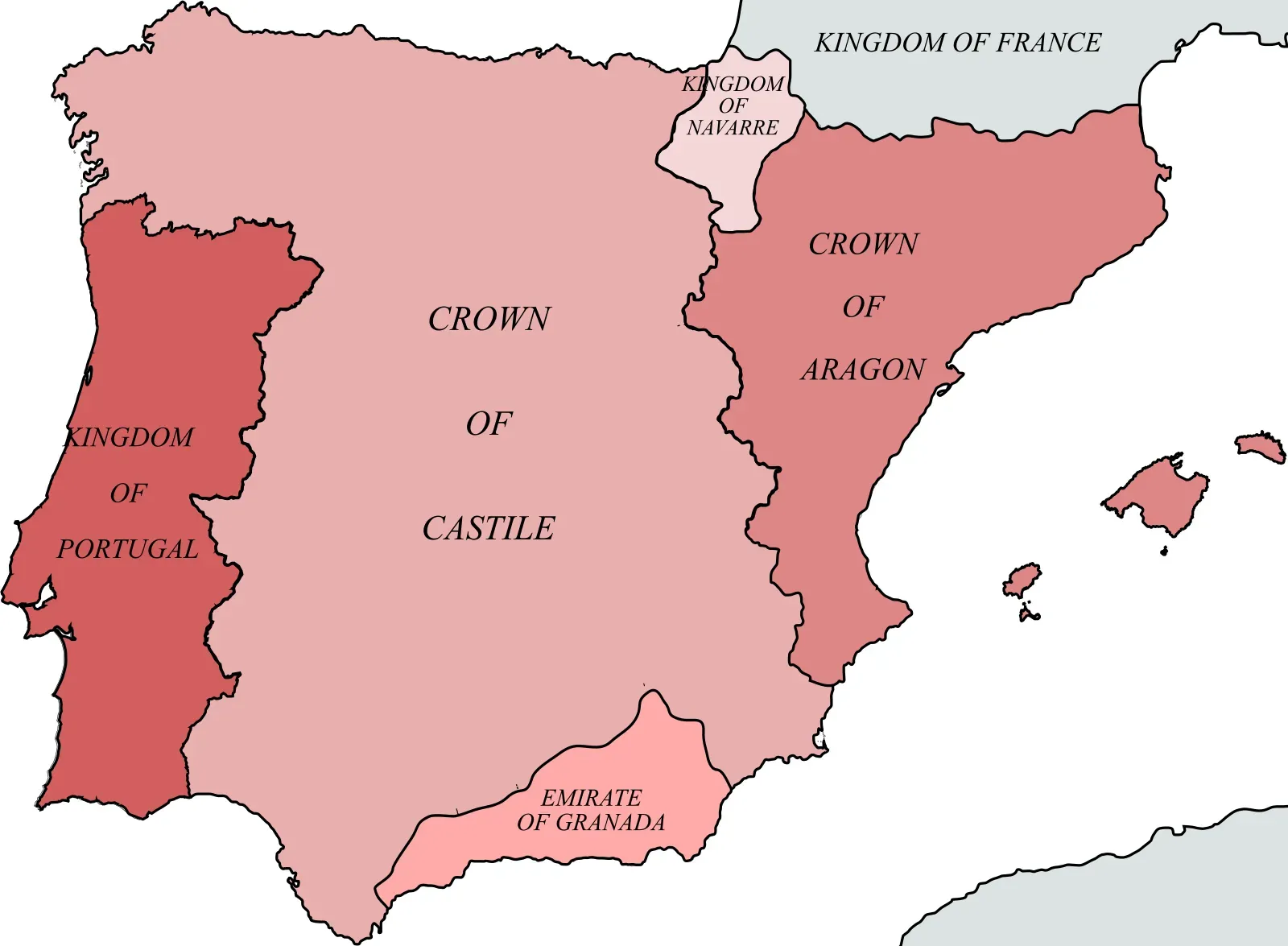
At first, it looks like a very mixed picture. But if you look more closely, all these languages belong to only three groups.
Romance languages, Arabic and Basque: three groups
Most languages on this map are Romance languages. They come from Latin, the language of the Romans, and that is why they are still very similar. Compare:
| Latin | Castilian | Galician | Portuguese | Catalan | Asturian |
|---|---|---|---|---|---|
| nox, noctis | noche | noite | noite | nit | nueche |
| filius | hijo | fillo | filho | fill | fíu |
| aqua | agua | auga | água | aigua | agua |
| lac, lactis | leche | leite | leite | llet | lleche |
(night · son · water · milk)
Even if you are just starting to learn Spanish, you can see the Latin roots in these words.
Arabic belongs to a completely different family: the Semitic family, like Hebrew and Aramaic. People spoke it in the Emirate of Granada. Granada was the last part of al-Andalus, the Muslim lands of the peninsula, that still existed.
But a long time before, al-Andalus also had its own Romance language. Historians call it Mozarabic. Arabic slowly took its place, and between the 11th and the 13th centuries many of its speakers escaped to the north, to the Christian kingdoms. There, Mozarabic mixed into the languages of the north. By around the 13th century, it had disappeared completely, long before the time of our map. Mozarabic disappeared. But the most mysterious language of the peninsula is still alive today.
Basque: a language with no relatives
The Basque Country was not a separate kingdom. The Basques lived in Navarre and in part of Castile. But their language, euskera, is the only language of the peninsula that does not come from Latin.
So where does it come from? We still do not know. Linguists have not found any relatives of Basque in any known language family. Languages like this are called "isolates". People spoke euskera here before the Romans arrived. The only language that experts connect with it is Aquitanian, an ancient language from the other side of the Pyrenees.
You can see the difference immediately:
| Castilian | Basque |
|---|---|
| noche | gau |
| hijo | seme |
| agua | ur |
| leche | esne |
| casa | etxe |
(night · son · water · milk · house)
There is not one common root.
So castellano was only one language among many on this map. But everything changed because of one wedding.
The wedding that changed the map: Isabella and Ferdinand
In 1469, Isabella of Castile married Ferdinand of Aragon. Above all, it was a union of the two strongest kingdoms of the peninsula.
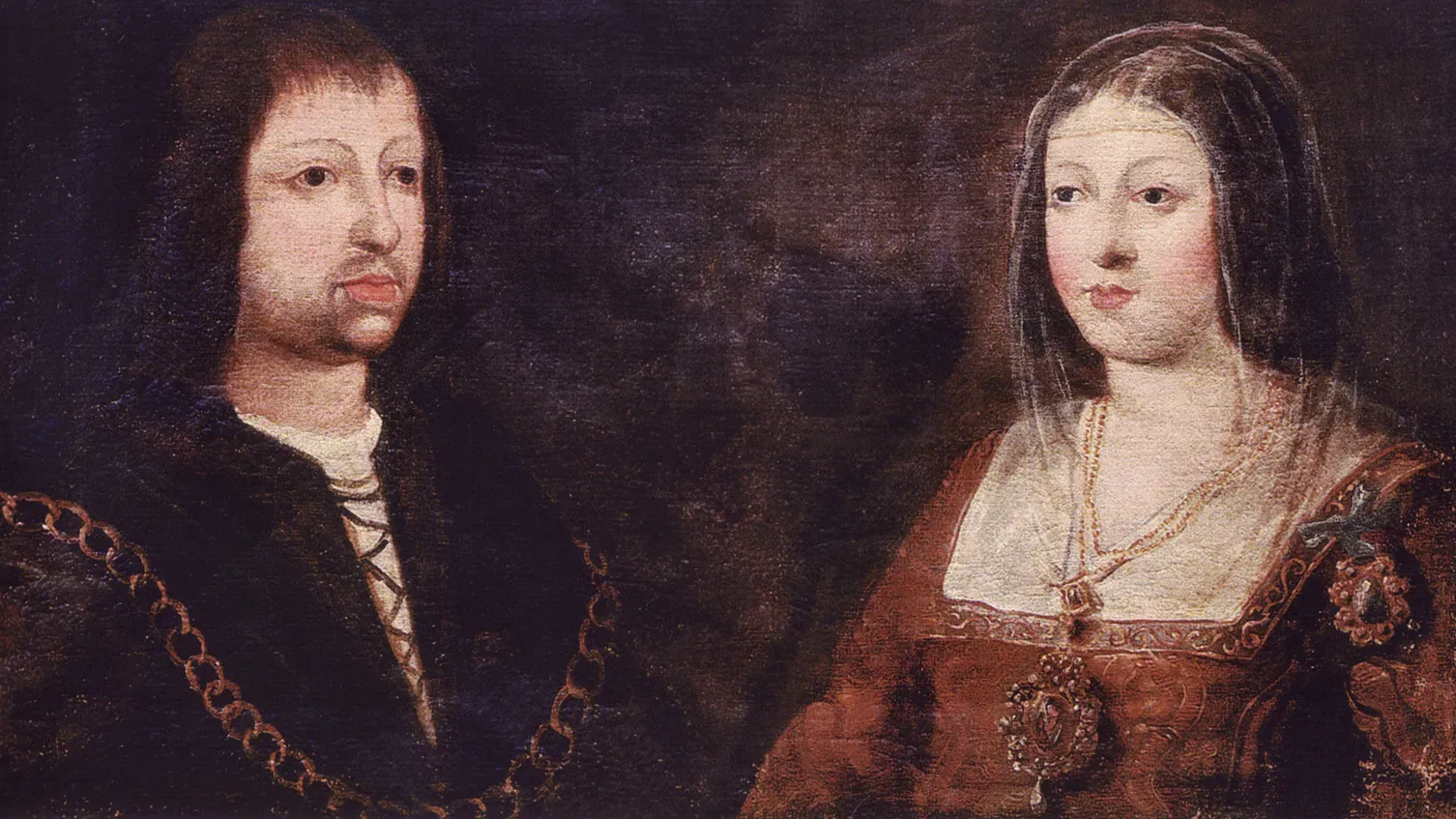
Each of them had their own language: Isabella had Castilian, and Ferdinand had Aragonese. So which language did they speak to each other? If we look at what happened next, it seems that Isabella made the decisions in this family.
But in reality, they probably did not need to choose. Ferdinand's family was originally from Castile: from 1412, the Trastámara family, which came from Castile, ruled Aragon. And in Aragon itself, during the 15th century, Castilian was slowly replacing Aragonese: first at court and among the nobles, and later in written documents. By 1500, almost all documents in Aragon were written in Castilian.
Castile was also much bigger than Aragon and had many more people. The historian Miguel Ángel Ladero Quesada estimates that about 4.3 million people lived in the Crown of Castile, and fewer than 900,000 in the Crown of Aragon. The wedding did not create one country: each kingdom kept its own laws and its own institutions. But these numbers already show which language more people spoke.
In the end, one single year decided the future of the language.
1492: three events in twelve months
On 2 January 1492, Isabella and Ferdinand entered Granada. This was the end of the Reconquista, the long fight for the southern lands that Muslims had ruled since the 8th century. Granada became part of the Crown of Castile. Castile was already the biggest kingdom with the most people, and now it became even stronger.
Then, on 18 August, Antonio de Nebrija published his "Gramática de la lengua castellana". It was printed in Salamanca, and there was a good reason for this. The University of Salamanca, founded in 1218, is one of the first universities in Europe, together with Paris, Oxford and Bologna. Nebrija taught grammar there for many years, and the city had printing presses: his Latin textbook, "Introductiones latinae", was printed there in 1481.
The "Gramática de la lengua castellana" was the first printed grammar of a Romance language in Europe.
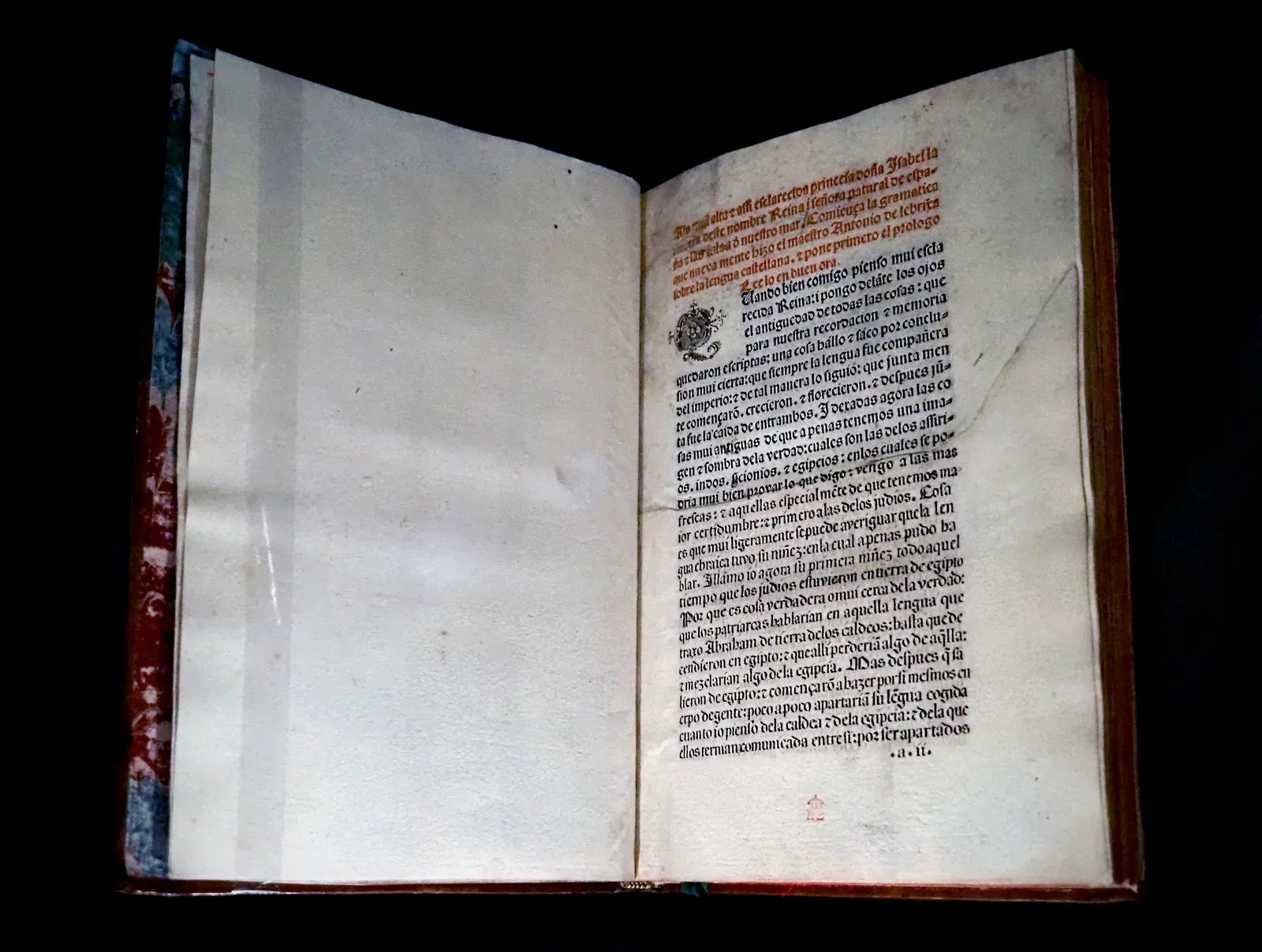
It is interesting that at first the queen did not understand why anyone needed this book. Nebrija gave his answer in the prologue, which he dedicated to Isabella: "siempre la lengua fue compañera del imperio" ("language was always the companion of empire"). Very soon, history showed that he was right.
And finally, in the same year, Columbus sailed to America. Both the queen and the king signed his contract, the Capitulations of Santa Fe, on 17 April 1492. But the new lands became part of the Crown of Castile. This decided everything: the language that crossed the ocean was Castilian, not Aragonese. Aragon was more interested in the Mediterranean Sea: it ruled Sicily and Sardinia, and in 1503 it also took Naples.
Spain started to build colonies, and Castilian slowly spread from Mexico to Argentina. It changed from the language of one kingdom into the language of a whole empire.
Notice something: in all these events, the language is called castellano. Nebrija's grammar does not say español, and the royal court does not say it either.
Where do the words España and español come from?
The word España comes from Hispania. This was the Roman name for the whole peninsula, that is, the land of today's Spain and Portugal. The Romans arrived in 218 BC. In 197 BC, they divided the land they had conquered into two provinces: Nearer Spain and Further Spain (Hispania Citerior and Hispania Ulterior).
But where does the word Hispania come from? Nobody knows for sure. The most popular theory says it is Phoenician: the Phoenicians traded on these coasts long before the Romans. But experts still disagree about what it meant: "land of rabbits" (or, more exactly, of hyraxes, small animals similar to rabbits), "land of metalworkers" or "land of the north".
The word español did not appear in Castile, and not even on the peninsula. The dictionary of the Royal Spanish Academy (RAE) says that it came from Occitan (Provençal), a language of the south of France: espaignol, from medieval Latin Hispaniolus, "from Hispania". According to one theory, from the linguist Paul Aebischer, French pilgrims on the Way of St James brought the word to the peninsula.
However, for a long time people did not use the word much. While the land was a union of kingdoms under one crown, each with its own laws, language and traditions, it was not very natural to talk about "the language of Spain".
Everything changed in the 18th century. In 1700, Philip V became king. He was the first king from the Bourbon family. His Nueva Planta decrees (Decretos de Nueva Planta) ended the laws and institutions of the kingdoms of the Crown of Aragon: Valencia and Aragon in 1707, Majorca in 1715 and Catalonia in 1716. After that, the old kingdoms had the same laws and the same government. Only Navarre and the Basque Country kept their own laws.
But even then, people used both names for a long time. In 1780, the Royal Spanish Academy published its dictionary with the title "Diccionario de la lengua castellana". It got the name it has today only in 1925: "Diccionario de la lengua española".
And now that we have both words, we can go back to the door of that school.
So what is written on the door?
Two names. One language.
Castellano and español are the same language.
Castellano is the historical name. It reminds us where the language was born: in the medieval kingdom of Castile. The Spanish state still uses this word today. On the websites of the Spanish government and of the BOE, the official bulletin where laws are published, the menu calls the language Castellano.
Español reminds us that the language became common to all the kingdoms of the crown, and later, because the new lands across the ocean belonged to Castile, to many countries in America too.
So why do people in Spain still say castellano so often? Remember the map of the 15th century: people on the peninsula always spoke several languages, and they still do. That is why many Spanish people, especially in Catalonia, the Basque Country and Galicia, prefer the word castellano. It makes it clear that this is one of the languages of Spain, not the only one. The Spanish Constitution says the same: "El castellano es la lengua española oficial del Estado" ("Castilian is the official Spanish language of the State", article 3). The other languages of the country are official in their own autonomous communities.
Outside Spain, people choose español. For example, Spanish is one of the six official languages of the United Nations.
Castellano or español: which word should you use?
The Royal Spanish Academy (RAE) says that both names are correct, and that the old discussion about which one is better is over. In practice, three simple rules can help you:
- On a form, in your CV, when you speak with people from other countries: español. Everyone in the world understands this name, and the RAE prefers it because it has only one meaning.
- When you talk about the languages of Spain, for example together with Catalan or Galician: castellano. This is what Spanish people say.
- When you talk about the history of the language: castellano too. It is the name of the language that was born in medieval Castile.
And if you say "hablo un poco de español" or "hablo un poco de castellano" at that school, they will understand you equally well.
Now you know what the language is called. The next step is to find out how well you speak it.
Take the free Spanish level test →
Sources
The language and its names
- RAE and ASALE. Diccionario panhispánico de dudas, "español". https://www.rae.es/dpd/español
- RAE. Diccionario de la lengua española: "español", "noche", "hijo", "agua", "leche". https://dle.rae.es/español
- RAE. History of the Academy (the dictionaries of 1780 and 1925). https://www.rae.es/la-institucion/historia
- Spanish Constitution, article 3. BOE. https://www.boe.es/buscar/act.php?id=BOE-A-1978-31229
- United Nations, official languages. https://www.un.org/es/our-work/official-languages
- Language menus: https://www.boe.es · https://www.lamoncloa.gob.es
The languages of the peninsula
- Etxepare Basque Institute, history of the Basque language. https://www.etxepare.eus/en/a-journey-through-the-history-and-evolution-of-a-language
- Elhuyar, Basque–Spanish dictionary: ur, gau, etxe, seme, esne. https://hiztegiak.elhuyar.eus/eu_es/ur
- Dictionaries of the academies: Real Academia Galega (https://academia.gal/dicionario), Priberam (https://dicionario.priberam.org), DCVB of the Institut d'Estudis Catalans (https://dcvb.iec.cat), DALLA of the Academia de la Llingua Asturiana (https://www.diccionariu.alladixital.org)
- Cenname, "romance andalusí", Normas journal (2016). https://dialnet.unirioja.es/descarga/articulo/5717316.pdf
- Gordón, University of Seville (lecture, University of Málaga). https://riuma.uma.es/bitstreams/e4739252-87fe-4533-b29f-973c3e98658b/download
- University of Cádiz, prologue to the Vocabulista by Pedro de Alcalá (the Arabic of Granada). https://publicaciones.uca.es/wp-content/uploads/2023/07/Prologo-Vocabulista.pdf
- González Ollé, "romance navarro". https://dialnet.unirioja.es/descarga/articulo/15687.pdf
History
- Ladero Quesada, "El mundo económico de Isabel la Católica", Icade. https://revistas.comillas.edu/index.php/revistaicade/article/download/6462/6273/14120
- Joseph Pérez, "Isabel I" portal, Biblioteca Virtual Miguel de Cervantes. https://www.cervantesvirtual.com/portales/isabel_i_la_catolica/epoca_biografia/
- Bautista, review of G. Tomás Faci, "El aragonés medieval", Edad Media 22 (2021): how Castilian replaced Aragonese. https://revistas.uva.es/index.php/edadmedia/en/article/download/5382/3913
- Cingolani, review of the same book, Medievalismo 30 (2020): the Castilian origin of the royal family. https://revistas.um.es/medievalismo/article/download/455881/293421/1553991
- University of Salamanca, history of the university. https://www.usal.es/historia
- Biblioteca Virtual Miguel de Cervantes, "Elio Antonio de Nebrija" portal: biography (https://www.cervantesvirtual.com/portales/elio_antonio_de_nebrija/autor_biografia/), first editions (https://www.cervantesvirtual.com/portales/elio_antonio_de_nebrija/su_obra_primeras_ediciones/)
- Real Academia de la Historia: Ferdinand II (https://historia-hispanica.rah.es/biografias/16453-fernando-ii-de-aragon-y-v-de-castilla), the taking of Granada (https://historia-hispanica.rah.es/hechos/1444412-1492-2-i), Philip V (https://historia-hispanica.rah.es/biografias/15737), Gnaeus Scipio (https://historia-hispanica.rah.es/biografias/12022)
- Biblioteca Nacional de España: "Gramática castellana" (https://www.bne.es/es/colecciones/incunables/incunables-espanoles/gramatica-castellana), guide to grammars (https://www.bne.es/es/Micrositios/Guias/Lengua/Gramaticas/)
- RAE, edition of the "Gramática sobre la lengua castellana", introduction. https://rae.es/sites/default/files/hojear_gramatica_sobre_la_lengua_castellana.pdf
- UNESCO Memory of the World: the Capitulations of Santa Fe (https://media.unesco.org/sites/default/files/webform/mow001/santa_fe_capitulations.pdf)