
Conversation Club "Once Upon a Time at the Prado"
Speaking course · B1+
- 20 classes of 90 minutes
- once a week, about 5 months
- group of up to 4 people of the same level
- live online with a native-speaker teacher
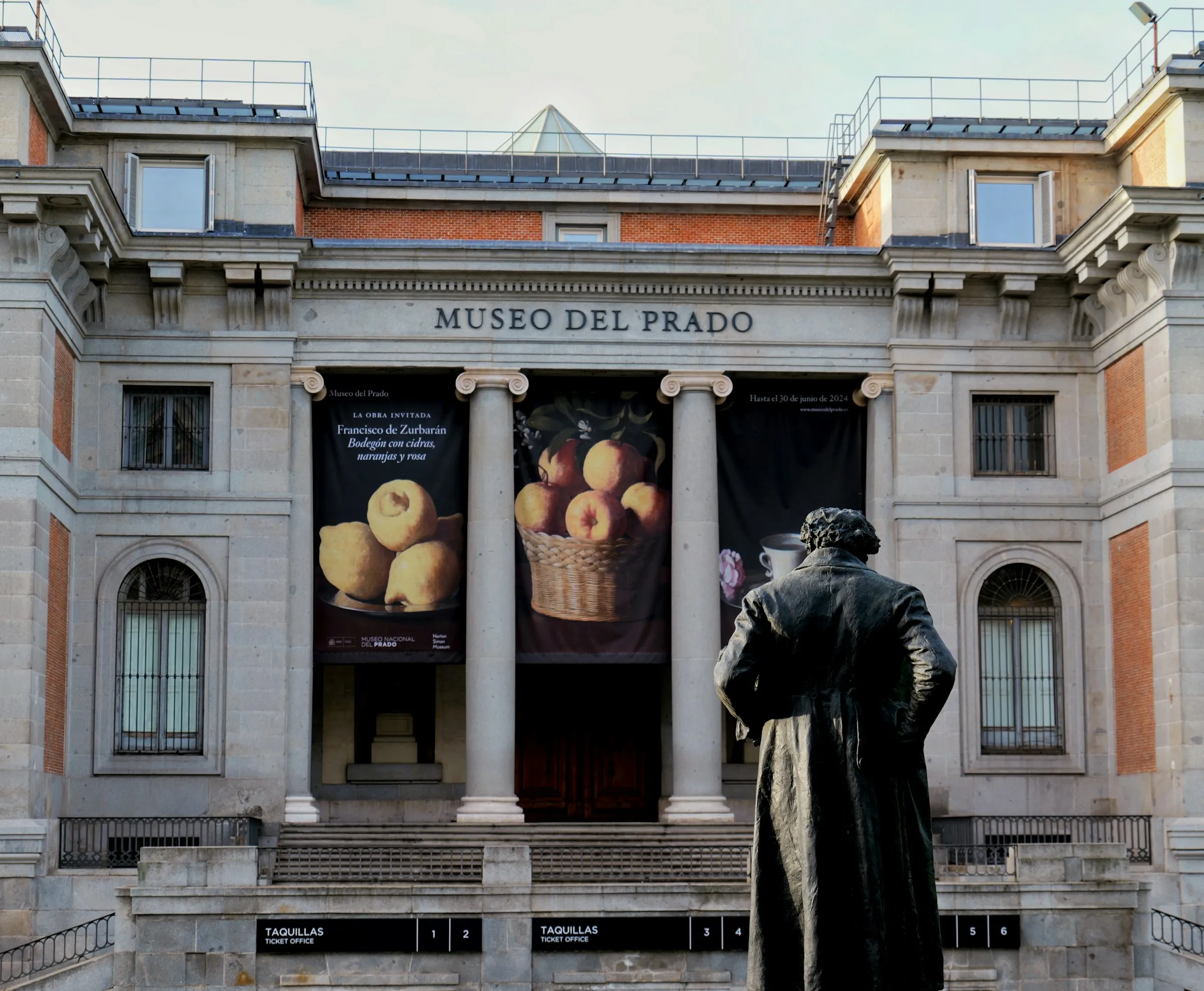
You know the grammar, but in conversation the words come too slowly? In this course, each class is about one painting from the Prado Museum. We will look at it closely, try to solve its mysteries, learn the story behind it and discuss what it tells us about our lives today. You will learn to describe, tell stories, make guesses and defend your opinion freely — and you will also learn a lot about the history and art of Spain.
Who this course is for
For people who already use the main tenses with confidence and now want to speak freely. If you have finished our B1 course or already speak at B1 level or above, this course is right for you. You do not need to know anything about painting: you will get everything you need to know about the painting and its time before the class.
And if you are not sure about your level, you can take our free Spanish level test →
What you will learn
Speaking and communicating
- describe in detail what you see: people, their appearance, clothes, poses and mood
- make guesses about things nobody knows for sure: "who is this person?", "what happened here?"
- talk about historical events in the past tense
- report what other people said: who said what and what they asked for
- talk about feelings and discuss difficult topics: war, power, beauty, mental health
- give your opinion, agree and disagree
- present a topic to an audience and answer their questions
Listening
- native speakers talking at normal speed — the teacher and the other students
- short videos and audio recordings about the paintings and their time
Reading
- articles in Spanish about paintings and historical events
Vocabulary
- art and painting, history, power and war, feelings and character, fashion and everyday life
Grammar in conversation
- the future and the conditional for guesses: «será un noble», «tendría unos treinta años»
- past tenses in storytelling (indefinido, imperfecto, pluscuamperfecto) and the passive voice: «fue pintado para…»
- reported speech (estilo indirecto): «Apolo le dijo que…»
- the subjunctive for opinions, judgements and feelings: «no creo que…», «me sorprende que…»
- conditional sentences: «si viviera en este jardín…», «si hubiera nacido en 1777…»
Programme
The course follows the levels of the Common European Framework of Reference for Languages (CEFR) and is based on the Instituto Cervantes curriculum (Plan Curricular del Instituto Cervantes) and the programmes of Spain's state language schools (Escuelas Oficiales de Idiomas).
The course has four blocks of five classes. Each block has its own big topic and its own grammar, which we practise in conversation. In the first four classes of each block, we look at one painting per class, and in the fifth class you do a project where you use everything you have learnt in that block.
Block 1. Misterios del Prado — describing and making guesses
- Las meninas (Velázquez): who are all the characters looking at?
- El caballero de la mano en el pecho (El Greco): who is this man?
- La Gioconda del Prado: a copy of the "Mona Lisa", hidden under a black background
- El perro (Goya): what does a painting with almost nothing in it mean?
- Project "Expediente X del Prado": you investigate a mystery of the museum and present your own theory
What we study: the future and the conditional for guesses, puede que and quizás with the subjunctive, ser and estar in descriptions.
Block 2. El poder y su imagen — telling history and looking at how an image is created
- Carlos V en Mühlberg (Titian): the emperor after a great victory
- Felipe II (Titian): the king in armour and a great collector
- La rendición de Breda (Velázquez): the winner comforts the loser
- La familia de Carlos IV (Goya): was the painter laughing at the royal family?
- Project "Juicio a la historia": we put one of the kings on trial — with a prosecution, a defence and a jury
What we study: past tenses in storytelling, the passive voice, the conditional.
Block 3. Pasiones humanas — reporting what others said and talking about feelings
- La fragua de Vulcano (Velázquez): Apollo brings Vulcan bad news
- Doña Juana la Loca (Pradilla): a mad queen or a victim?
- El 3 de mayo de 1808 (Goya): Goya as a witness of war
- Saturno devorando a su hijo (Goya and Rubens): two Saturns and Goya's dark paintings
- Project "Si los cuadros hablaran": you interview a character from a painting and then report what they said
What we study: reported speech, the subjunctive for judgements and feelings.
Block 4. La belleza y la vida — comparing different times and imagining what would happen if…
- Las tres Gracias (Rubens): the ideal of beauty — from Rubens to Instagram
- El quitasol (Goya): how people relaxed and dressed in 18th-century Madrid
- Las hilanderas (Velázquez): the myth of Arachne, who challenged a goddess
- El jardín de las delicias (Hieronymus Bosch): paradise, pleasures and hell
- Final class "Hoy soy guía del Prado"
What we study: conditional sentences, comparisons, the imperfecto to describe how people lived in the past.
What the classes are like
Before each class, you get the topic for discussion as an article, plus audio and video materials to study. This way you come to class prepared.
In class, we first share our first impressions and look at the painting: we describe the characters, gestures and details. Then, together with the group, you tell the story of the painting using the materials you studied at home. The main part of the class is a mystery, a debate about what the painting means for us today, or a role play. The grammar topic of the block is part of the conversation all the time: we practise it in real speech, not in exercises.
The teacher does not interrupt you: they note your mistakes and go through them at the end of the class.
There are only four people of the same level in the group, so each person speaks about two and a half times more than in a conversation club with 10 people.
All materials — articles, audio and video materials, vocabulary lists and Quizlet flashcards — are included in the course price.
How we assess your progress
Each block ends with a project: an investigation, a trial, an interview. It shows the teacher how you use the grammar and vocabulary of the block, and the teacher gives you feedback.
In the last class, you become a guide to the Prado. You choose a painting from the museum that we have not studied in the course and present it to the group: what it shows, the story behind it and why you chose it.
The teacher assesses:
- fluency;
- vocabulary;
- grammatical accuracy;
- how well you answer the group's questions.
Each student receives written feedback: what went well and what to work on next.
From €20 per class*
*When you pay for the full course of 20 classes.
Ready to start the course "Once Upon a Time at the Prado"?
To start, you only need to fill in a short form: we will look at your level and find a group for you.