
Can a person forget how to read?

Social media clearly shows how we feel about reading. Some years ago, Facebook, Instagram and other platforms were places where people shared personal or professional content with texts and photos. People wrote long captions, and other people read them. Today most users mainly scroll through videos.
This is not just an impression. In 2021, the head of Instagram, Adam Mosseri, said it directly: "We're no longer a photo-sharing app or a square photo-sharing app." Data from the Reuters Institute at the University of Oxford show the same change. Every year, the institute asks people in dozens of countries how they get their news. In 2025, people from 48 countries on 6 continents took part. On average in all these countries, the share of people who get news from videos on social media grew from 52% in 2020 to 65% in 2025. More and more often, we watch instead of reading. And it is not only the habit of reading news and other information that is falling. People also want to read for pleasure less.
In the United States, for example, a study by the University of Florida and University College London was published in the journal iScience in 2025. It showed that in 2004 only 28% of Americans read something for pleasure on a normal day. In 2023, this number fell to 16%.
In the same year, 2025, the UK charity National Literacy Trust did its annual survey. Only 32.7% of children and young people aged 8 to 18 said they enjoyed reading. This was the lowest result in 20 years.
In September 2026, the results of the largest PISA study in history were published. PISA is organised every few years by the Organisation for Economic Co-operation and Development (OECD). The OECD has 38 member countries, including the United States, the United Kingdom, Germany, Spain, Japan and Mexico. PISA tests how well 15-year-old students can use reading skills and their knowledge of maths and science in real life. Countries that are not OECD members can also take part. So the latest study, which took place in 2025, included 760,000 students from 91 countries. The result: the average reading score in OECD countries was the lowest in the history of the study. In 10 years, from 2015 to 2025, it fell by 28 points, from 489 to 461.
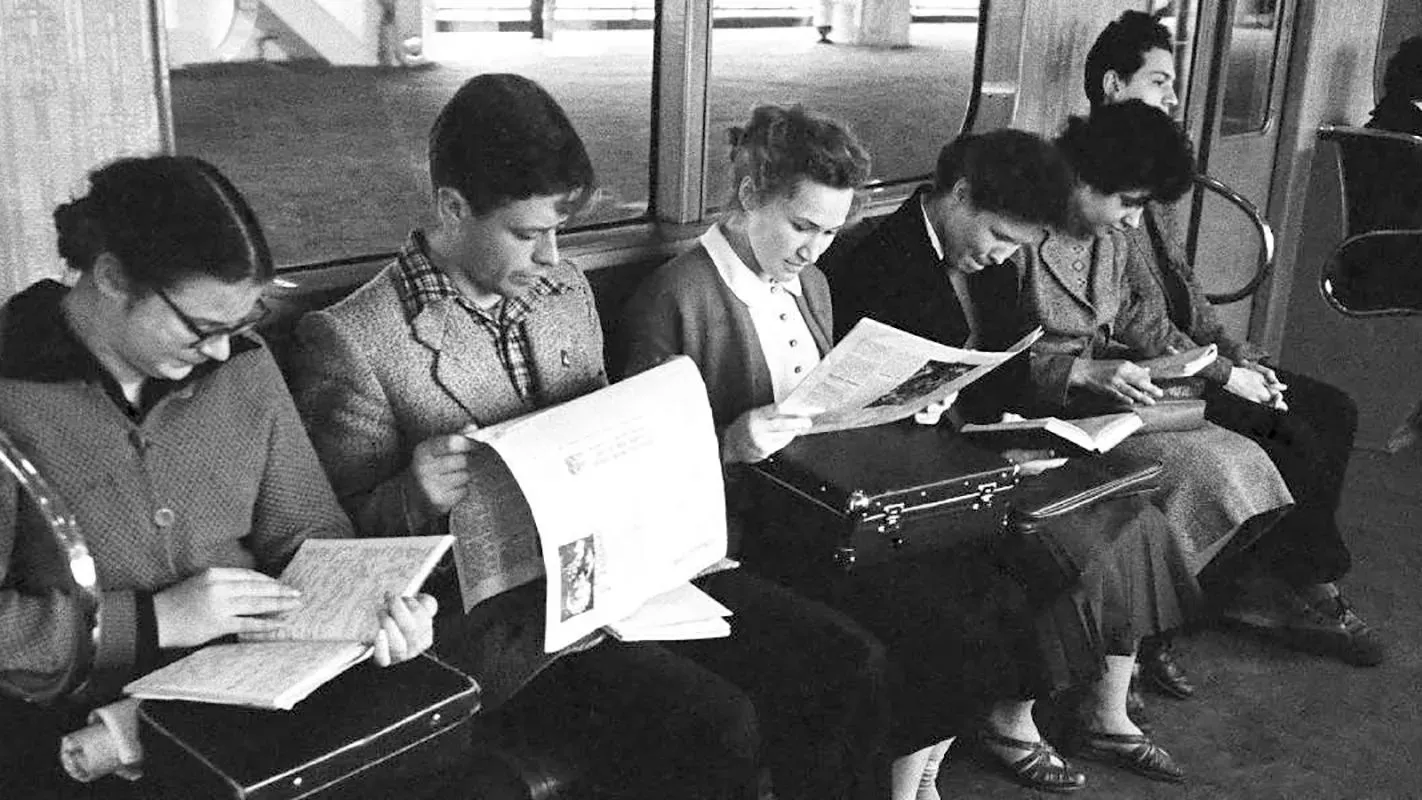
We read less and less. And this is not just a new stage of development. It is a direct threat to our ability to read a text deeply and understand it, to our critical thinking and to our ability to concentrate. In this article, we will look at whether a person can forget how to read.
Reading is a young invention
Today there is text everywhere you look: on your phone screen, on a bottle of shower gel, on medicine boxes. But it was not always like this.
Writing appeared quite recently. The first written records that scientists know about appeared a little more than 5,000 years ago in Mesopotamia, in the area of modern Iraq. They were not books. They were clay tablets with economic records. People wrote on wet clay with a stick made from a reed: they drew simple signs and numbers. In this way, temples kept records of how much grain, fish or livestock they received and who they gave it to.

For evolution, 5,000 years is a very short time: it is only about 200 generations. In this time, the human body and brain have almost no time to change. For example, our ancestors needed about 4 million years to learn to walk on two legs. According to the Smithsonian Institution, the first signs of walking upright are found in ancestors who lived about 6 million years ago. But a body made for walking long distances, like ours, appeared only about 1.9 million years ago.
In 5,000 years, the brain could not create a special part only for reading. This is why neuroscientists believe that there is no special "reading area" in our brain.
What happens to the brain when we learn to read?
Because there is no special "reading area", the brain has to create one. In a BBC World Service video, the researchers Maryanne Wolf and Rebecca Gottlieb explain it like this: when a person learns to read, the brain uses areas that work with vision, hearing, language, attention and emotions, and it connects them in a new network.
In 2010, a group of scientists led by the French neuroscientist Stanislas Dehaene showed how this works in practice. They invited 63 adults from Portugal and Brazil with very different life stories:
- 10 people never learned to read;
- 22 people learned to read only as adults, in literacy classes. They could read, but quite slowly;
- the others learned to read as children, as usual.
Each participant went into a brain scanner, which shows which areas of the brain are working at each moment. On a screen, they saw faces, houses, tools, lines of letters and chessboard patterns. They also listened to spoken sentences and single words.
The results were very clear:
- In people who can read, a special area responds to written words. It is in the lower part of the left side of the brain, between the occipital lobe and the temporal lobe. Scientists call it the "visual word form area". The better a person reads, the more strongly this area responds to text.
- In people who cannot read, this area almost does not respond to letters. But it responds more strongly to other images, for example to faces. So reading seems to "win" its place from other visual tasks.
- When a person who can read hears speech, the area that processes speech sounds works twice as strongly. Spoken words even activate the visual word form area. A brain that can read really "sees" what it hears.
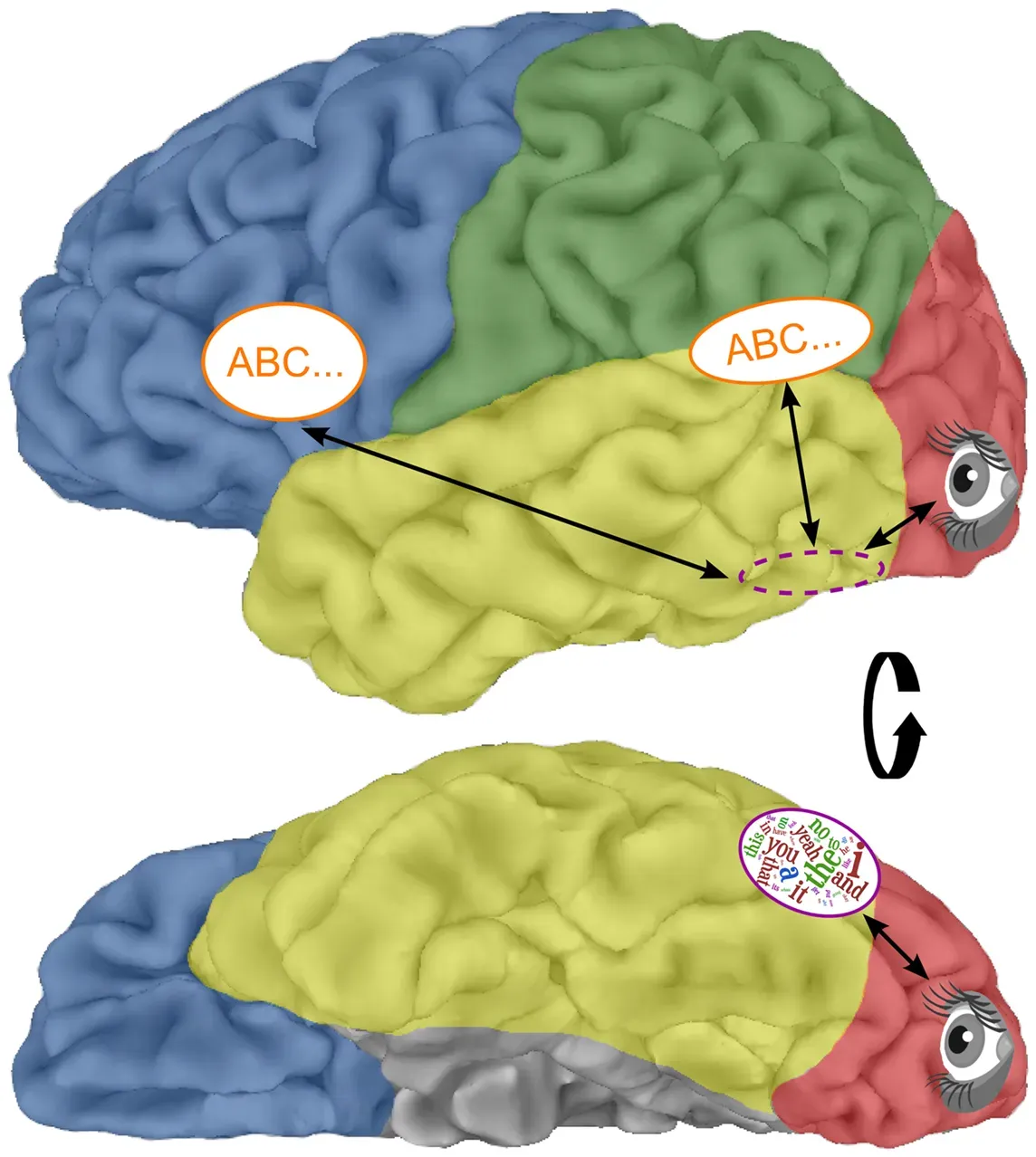
And the most important thing: the scientists found all these changes in people who learned to read as adults, too. The brain can change at any age.
But if reading changes the brain so much, the place where we read is also important.
Screen or paper?
In 2013, researchers from the Reading Centre at the University of Stavanger in Norway did a simple experiment. They invited 72 students aged 15–16 from 2 schools and put them into 2 groups at random. Both groups read the same 2 texts of 1,400–2,000 words: a story and an information article. One group read on paper, and the other group read a PDF on a computer screen. After that, everyone answered questions. The students who read on paper understood the texts much better.
One experiment could be a coincidence. So in 2018, scientists from the University of Valencia in Spain and the Israel Institute of Technology (Technion) collected all the similar studies from 2000 to 2017. There were 54 studies with 171,055 participants. All of them compared the same thing: the same texts on paper and on a screen. Then they tested how well people understood the content with questions.
Paper won. To show how big the difference is, the authors compared it with school. In one year of primary school, a child starts to understand texts much better. The advantage of paper is about 2/3 of this progress in one year. The difference was biggest when readers had limited time and when they read information texts, not fiction.
In 2019, the American researcher Virginia Clinton from the University of North Dakota analysed 33 experiments with 2,799 participants and added a surprising result. On a screen, people not only understand a text less well. They also judge their own understanding less well: they think they have understood more than they really have.
Of course, reading on a screen is better than not reading at all: reading itself is very useful. For example, in 2023, scientists from Fudan University in Shanghai and the University of Cambridge studied data on more than 10,000 American children. The children who started to read for pleasure at an early age did better at the age of 9–13 in tests of thinking and language, and they had fewer problems with attention. But if we want reading to really train our memory and attention, a printed book is still the best choice.
Can a person forget how to read?
Of course, we will not forget the letters. But reading is not only knowing the letters. It is the ability to understand a difficult text, to keep your attention on it and to compare ideas. And it seems that we can lose this ability.
In 2023, the OECD tested how well adults understand texts in 31 countries. In 10 years, adults' understanding of texts improved in only 2 countries: Denmark and Finland. In all the other countries, it stayed at the same level or became worse. This was true for different age groups and even for people with a university education.
A person can forget how to read deeply if they stop doing it. The researcher Maryanne Wolf noticed this in her own life. In her book Reader, Come Home (2018), she describes how she decided to read again a novel that she loved when she was young, and she could not do it. The text seemed too slow to her. Her eyes moved quickly over the lines without understanding the meaning, and she read the same sentences again and again. After many years of reading quickly on screens, she had lost what she called "cognitive patience". But, as Stanislas Dehaene's study from 2010 showed, the brain can change at any age, and we can recover this ability. Wolf made herself read slowly again, and in time the novel became again the book she remembered.
If you are learning Spanish and want to read books in Spanish, here is my advice:
- Read at your level. If there are too many new words and you cannot follow the story, choose an easier book: there are graded readers for every level.
- A little, but every day. Reading regularly is more important than the number of pages.
- When you can, read on paper. You understand the text better this way.
- Talk about what you read in your classes. Reading works best this way.
To choose a book at your level, first you need to know your level.
Take the free Spanish level test →
Sources
Social media and video
- Reuters Institute for the Study of Journalism (2025). Digital News Report 2025, Executive summary. https://reutersinstitute.politics.ox.ac.uk/digital-news-report/2025/dnr-executive-summary
- Adam Mosseri, video of 30/06/2021, published on his accounts. Quoted by Engadget: https://www.engadget.com/instagram-no-longer-a-photo-sharing-153127352.html
How much we read
- Bone, J. K., Bu, F., Sonke, J. K., Fancourt, D. (2025). "The decline in reading for pleasure over 20 years of the American Time Use Survey". iScience. https://www.cell.com/iscience/fulltext/S2589-0042(25)01549-4
- National Literacy Trust (2025). "Children and young people's reading in 2025". https://literacytrust.org.uk/research-services/research-reports/children-and-young-peoples-reading-in-2025
- OECD (2026). PISA 2025 press release, 08/09/2026. https://www.oecd.org/en/about/news/press-releases/2026/09/pisa-2025-students-reading-and-mathematics-performance-declined-sharply-across-the-oecd.html
- OECD: what PISA is (https://www.oecd.org/en/about/programmes/pisa.html); OECD member countries (https://www.oecd.org/en/about/members-partners.html)
- OECD (2024). Survey of Adult Skills 2023. https://www.oecd.org/en/publications/do-adults-have-the-skills-they-need-to-thrive-in-a-changing-world_b263dc5d-en.html
Writing, evolution and the brain
- Spar, I. (2004). "The Origins of Writing". The Metropolitan Museum of Art, Heilbrunn Timeline of Art History. https://www.metmuseum.org/essays/the-origins-of-writing
- Smithsonian Institution, Human Origins Program. "Walking Upright". https://humanorigins.si.edu/human-characteristics/walking-upright
- BBC World Service (2025). "How reading changes the way your brain works". https://www.youtube.com/watch?v=X1L1Hd3xfrU
- Dehaene, S. et al. (2010). "How learning to read changes the cortical networks for vision and language". Science 330, 1359–1364. https://doi.org/10.1126/science.1194140
Screen and paper
- Mangen, A., Walgermo, B. R., Brønnick, K. (2013). International Journal of Educational Research 58, 61–68. https://doi.org/10.1016/j.ijer.2012.12.002
- Delgado, P., Vargas, C., Ackerman, R., Salmerón, L. (2018). Educational Research Review 25, 23–38. https://doi.org/10.1016/j.edurev.2018.09.003
- Clinton, V. (2019). Journal of Research in Reading 42(2), 288–325. https://doi.org/10.1111/1467-9817.12269
Benefits of reading
- Sun, Y.-J., Sahakian, B. J. et al. (2024). Psychological Medicine 54(2), 359–373. https://doi.org/10.1017/S0033291723001381
Reading in another language
- Hu, M., Nation, P. (2000); Laufer, B., Ravenhorst-Kalovski, G. C. (2010). Reading in a Foreign Language 22(1), 15–30.
- Nation, P., Waring, R. (2020). Teaching Extensive Reading in Another Language. Routledge.
- Jeon, E.-Y., Day, R. R. (2016). Reading in a Foreign Language 28(2), 246–265. https://nflrc.hawaii.edu/rfl/item-detail/354
- Sangers, N. L. et al. (2025). Educational Psychology Review 37, 96. https://doi.org/10.1007/s10648-025-10068-6
Maryanne Wolf
- Wolf, M. (2018). Reader, Come Home: The Reading Brain in a Digital World. Harper. Extract: WBUR On Point, 21/08/2018. https://www.wbur.org/onpoint/2018/08/21/reader-come-home-maryanne-wolf